We leave you with a list of tips for travelling to Munich that we hope can help you organise your trip to one of the most incredible cities in Germany, the capital of Bavaria, where in addition to being able to visit it for a few days, you can take the opportunity to make a trip to the impressive Neuschwanstein Castle, a fairytale castle or visit the Dachau concentration camp, a painful and not easy visit, but which we believe is essential to understand the history and above all, to be aware of the barbarism that happened in this place.
Based on our trip to Bavaria, in which we wrote this guide to Munich, we leave you with what we believe are the 10 essential tips for travelling to Munich. Let's get started!
1. When is the best time to travel to Munich?
Although any time of year is a good time to travel to this part of Germany, we think it is important to take into account the weather and the places you want to visit to decide which is the best time to travel to Munich.
High season (July and August): these summer months are the best months to visit the city, although in recent times, temperatures tend to be quite high and at the same time, the most touristic places tend to be very crowded.
Mid-season (April to June and September to October): for us, this would be the best option as the weather is usually mild and most tourist attractions are not as crowded as in summer.
Low season (November to March): This is the greyest and coldest time of the year and the rainiest months. Unless you want to enjoy the city at Christmas, when the Christmas markets are set up, this is the least advisable time of year.
Don't forget that if you are going to travel in the months that are included in the high season or Christmas, it is highly recommended to book flights and accommodation in advance to have more options and find better prices.
2. Entry requirements
If you are a citizen of the European Union or Spanish, you will only need your ID card or passport to travel to Munich. If you have another nationality, we recommend that you carefully check the website of the embassy or the Ministry of Foreign Affairs.
In addition to these entry documents, it is very important to have a European Health Insurance Card in order to receive medical assistance if necessary. In addition to this, it is highly recommended to have the best travel insurance for Europe, with which you will receive the best medical care and you will also have repatriation included, if necessary.
Due to the current health situation, all Mondo insurances include medical assistance in case of coronavirus infection. Also included is the extra stay you need in case of quarantine infection and of course, the test in case it is necessary.
3. Safety
We can say that travelling to Munich is completely safe, although as in any destination in the world, especially in the most touristy places or in the busiest places, it is important to be careful and not leave personal belongings or valuables unattended, to avoid petty theft.
If you are travelling by car in the Bavarian region, it is also important not to leave valuables in plain sight in the car and always try to keep your luggage hidden. Thefts are rare, but travelling with common sense and avoiding making things easy for the unwary is the best way to avoid surprises.
In addition to this, it is highly advisable to upload a copy of all important personal documentation such as your ID card, passport, insurance policy or driving licence to the cloud before you start your trip to Munich, so that in the event of theft or loss, it will be quicker and easier to carry out any formalities.
 Munich
4. How do I start my trip to Munich?
The first and most important thing is to look for flights to Munich with any of the airlines that fly this route, including low cost airlines such as Ryanair. To do this, we recommend you check this flight search engine, which will help you find the best options at the best prices.
Once you have your flight, you can check this post on how to get from Munich airport to the city centre.
The next step is to look for your accommodation in Munich, for which we recommend you check this search engine for hotels in Munich, where you can see all the options that exist in the city and also get it at the best price.
Although there are hundreds of options, in our experience, we recommend the Hotel Eder, located 5 minutes from the historic centre and the train station, with spacious, clean and comfortable rooms. The breakfast is very complete and of high quality and it also has free wifi throughout the hotel and 24 hour reception.
Other hotels located close to the historic centre and offering excellent value for money are the Mercure München City Center, the Superior Hotel Präsident and the Hotel MIO by AMANO.
For more information on the best hotels and neighbourhoods, check out this post on where to stay in Munich.
With these points solved, the next point is to assess which excursions you want to do in Munich, especially if you are travelling in high season, so you can book them in advance and make sure you have a place. You can see all the excursions and tours in Munich here.
 Booking in advance is one of the best tips for travelling to Munich.
5. Munich sightseeing tour
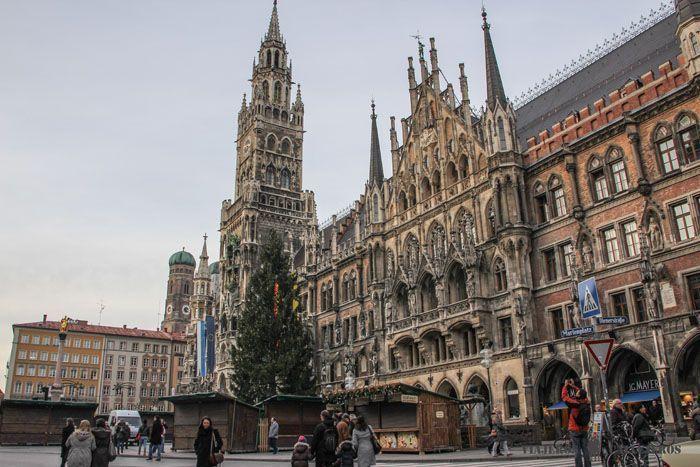
Known for being the capital of Bavaria and one of the most beautiful cities in Germany, Munich is a must on any trip to Germany, where you can not miss among many other places its historic centre in which stand out the impressive Marienplatz with the New Town Hall, Viktualienmarkt or stop at the Hofbräuhaus Brewery, which is one of the essential things to do in Munich, and then relax with a walk through Englischer Garten and visit Residenz, among many other essential places to visit in Munich.
Based on our visit to the city and to make it easier for you to get around the city, we leave you these guides optimised by days:
Munich in one day
Munich in two days
Munich in 3 days
Although our recommendation is to have 2 days to get to know the city, it is highly recommended to leave one or two more days to visit the impressive Neuschwanstein Castle, the Dachau concentration camp or take a trip to Salzburg, all of them considered as some of the best tours and excursions from Munich.
 Residenz, one of the places to visit on a trip to Munich.
6. Bavarian Tour
If after travelling to Munich you have a few extra days, something we highly recommend is to rent a car or opt for an organised tour to get to know the area of Bavaria, one of the must-see places in Germany, which we are sure you will not be disappointed.
Although the tour can take several days, with 4-5 days you can visit the most touristic places among which are the city of Munich, the Neuschwanstein Castle, Fussen and the village of Oberammergau, known as the "fairy tale" village, due to the paintings in some of its houses, and the Dachau concentration camp, which we understand is a painful visit, but at the same time, we believe it is highly recommended.
You can find out more about this area by reading this post on essential travel tips for Bavaria.
 Oberammergau
Although all these places can be visited on your own in a rental car, another interesting option, especially if you want to learn about the history of the area with an English-speaking guide, is to book one of these excursions:
If you want to extend your route through the country, we recommend you to read the post 10 essential tips for travelling to Germany.
7. Neuschwanstein Castle
Located in the impressive Bavaria, Neuschwanstein Castle is one of the best tours and excursions in Munich and one of the places we recommend you not to miss when travelling to Munich.
Just 130 kilometres from the city, this castle was built on the orders of King Ludwig II, known as the Mad King, and is considered one of the most impressive castles in the world, as well as being the reference point for Walt Disney's famous Sleeping Beauty Castle.
Besides the visit to the castle, one of the things you can't miss are the spectacular views from the Marienbrücke or Mary's Bridge, which we are sure will be the perfect complement.
This visit can be done on your own, by rental car or train if you're touring Bavaria or as a day trip from Munich. Another option is to book this Excursion to Neuschwanstein Castle and Linderhof Palace or this Excursion to Neuschwanstein Castle by train.
For more information you can check this post on how to get to Neuschwanstein Castle and this one on how to visit Neuschwanstein Castle.
 Neuschwanstein Castle
8. Dachau Concentration Camp
The Dachau Concentration Camp is another one of the day trips we recommend you to do when travelling to Munich. Although we know that this visit is not pleasant, we believe that it is necessary and very important to learn about the history of this country and above all, what happened in this horrible episode of our history, in which millions of people were murdered solely because of their race, political ideas or religion.
Located 20 kilometres north of Munich and a journey of approximately 45 minutes, the Dachau concentration camp was active for 12 years after its construction in 1933 and was used as a camp for political prisoners until 1941 when it became a horrible extermination camp through which more than 200,000 prisoners passed, of which 40,000 were murdered.
This visit can be done on your own, by car or by public transport, taking the S-Bahn train for a 20-minute ride and then the 726 bus that will take you directly to the concentration camp.
Another option, much more recommendable if you want to know everything that happened in this place, from the hands of an expert in Spanish, is to book this Excursion to the Dachau concentration camp.
 Dachau Concentration Camp
9. German gastronomy
Although it is impossible to condense in just a few lines all the German gastronomy, in this post we want to give you a selection of some of its best dishes, so that when you travel to Munich you can try them and make your trip a complete experience.
Pork knuckle: pork cooked in the oven with pea puree usually added.
Kartoffelsalat: potato salad.
Kartoffelsuppe: This is one of the country's most famous soups. It is made with potatoes, onions, carrots and spices.
Pretzel: a kind of savoury bread, round or loop-shaped, which can be found in most bakeries in the country.
Sauerkraut: Sauerkraut is a fermented cabbage that serves as a garnish for many German dishes, including the famous German sausages.
Currywurst: although there are dozens of ways to cook and serve them, one of the most famous is currywurst, a sausage to which curry is added and usually served with potatoes.
Apfelstrudel: apple pie - delicious!
 Currywurst
In Munich, we recommend at least once a visit to the famous Hofbraühaus beer hall, an institution in the city, which, although very touristy, serves quality food and beer. We ordered a plate of the house, with 3 types of sausages, another with bratwurst with sauerkraut, a plate of baked potatoes, plus a half-litre glass of beer and a coke for 26 euros.
For more information, check out this post on the best restaurants to eat in Munich.
10. More tips for travelling to Munich
Other top tips for travelling to Munich:
Although the official language is German, English is spoken in most tourist places, so you won't have any problems.
However, if you want to raise a smile, we recommend you learn a few German words such as hallo (hello), buenos dias (guten morgen), buenas tardes (guten abend), buenas noches (guten nacht), hasta luego/ hasta pronto (auf wiedersehen), si (ja), no (nein), gracias (danke) and de nada (bitte).
Although the euro is used in Germany, remember that in order to avoid paying commissions and to always have the current exchange rate, we recommend using the Revolut card and the N26 card, which we use, are free of charge and will save you a lot of money. You can find more information in this article on the best cards for commission-free travel.
If you're driving, don't forget that in Germany there is no speed limit on some stretches of motorway. However, always drive with caution and respect the signs and regulations.
In Germany, the voltage is 230V, the frequency is 50 Hz and the plugs are type F.